
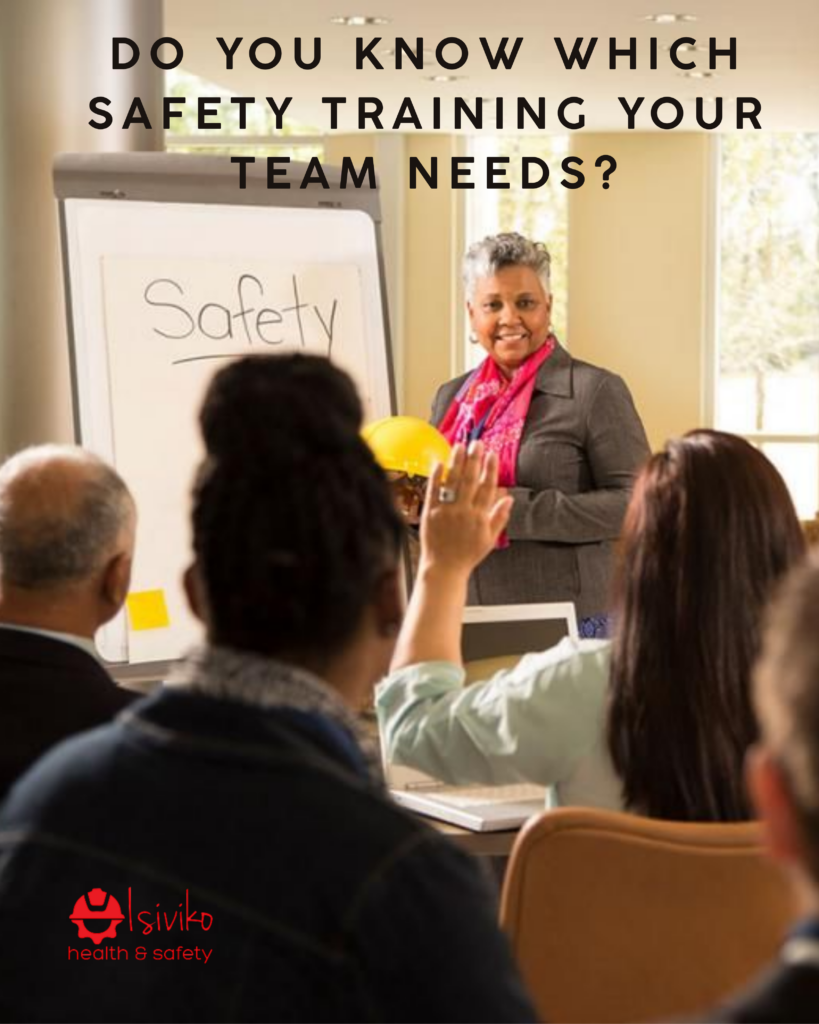
Your employees face different risks depending on their jobs, equipment, work environment and level of responsibility. Sending every employee on the same course does not create an effective safety system.
South Africa’s Occupational Health and Safety Act places a duty on employers to provide employees with the information, instruction, training and supervision needed for safe work.
𝐓𝐡𝐞 𝐤𝐞𝐲 𝐪𝐮𝐞𝐬𝐭𝐢𝐨𝐧 𝐢𝐬 𝐬𝐢𝐦𝐩𝐥𝐞.
Does your current training match the risks your employees face every day?
𝐒𝐭𝐚𝐫𝐭 𝐖𝐢𝐭𝐡 𝐘𝐨𝐮𝐫 𝐖𝐨𝐫𝐤𝐩𝐥𝐚𝐜𝐞 𝐑𝐢𝐬𝐤 𝐀𝐬𝐬𝐞𝐬𝐬𝐦𝐞𝐧𝐭
A risk assessment provides one of the best starting points for identifying training needs.
Look at each task performed in your workplace and identify:
Who performs the task?
What hazards are involved?
What equipment or machinery is used?
Which chemicals or substances are handled?
What level of supervision is required?
What would happen if someone performed the task incorrectly?
Once you understand the risks, training requirements become much clearer.
A warehouse employee operating lifting equipment faces different risks from an office employee. A construction worker working at height needs different knowledge from an employee handling hazardous chemicals.
Training needs should follow workplace risk.
Match Training to the Employee’s Role
Job titles alone do not give enough information.
𝐋𝐨𝐨𝐤 𝐚𝐭 𝐰𝐡𝐚𝐭 𝐞𝐚𝐜𝐡 𝐞𝐦𝐩𝐥𝐨𝐲𝐞𝐞 𝐝𝐨𝐞𝐬 𝐝𝐮𝐫𝐢𝐧𝐠 𝐚 𝐧𝐨𝐫𝐦𝐚𝐥 𝐰𝐨𝐫𝐤𝐢𝐧𝐠 𝐝𝐚𝐲.
Employees working with machinery need instruction on safe operation, hazards, emergency procedures and relevant controls.
Employees exposed to hazardous chemicals need training linked to those substances, exposure risks, safe handling, protective measures and emergency procedures. South Africa’s Regulations for Hazardous Chemical Agents specifically address information, instruction and training for employees exposed to hazardous chemical agents.
Employees working on construction sites need training suited to site hazards, work activities and their responsibilities. Construction regulations also place clear emphasis on induction, competence and safety management.
The goal is not to send employees on as many courses as possible.
The goal is to give each person the knowledge and practical competence needed for safe work.
𝐊𝐧𝐨𝐰 𝐖𝐡𝐢𝐜𝐡 𝐓𝐲𝐩𝐞𝐬 𝐨𝐟 𝐓𝐫𝐚𝐢𝐧𝐢𝐧𝐠 𝐀𝐩𝐩𝐥𝐲 𝐭𝐨 𝐘𝐨𝐮𝐫 𝐁𝐮𝐬𝐢𝐧𝐞𝐬𝐬
Training requirements differ between industries and workplaces.
Depending on your operations, employees might need training covering areas such as:
Workplace Health & Safety induction
Health & Safety Representative training
First aid
Fire and emergency response
Hazard identification and risk assessment
Incident reporting and investigation
Personal protective equipment
Hazardous chemical agents
Working at heights
Construction site safety
Machinery safety
Lifting machinery operation
Safe work procedures
Supervisor Health & Safety responsibilities
Specific training requirements often depend on workplace hazards, applicable regulations, equipment and employee responsibilities.
For lifting machinery, South Africa also has specific requirements around operator competence and approved training. The Department of Employment and Labour introduced an amended National Code of Practice for lifting machinery operator training in April 2025.
𝐃𝐨 𝐍𝐨𝐭 𝐂𝐨𝐧𝐟𝐮𝐬𝐞 𝐈𝐧𝐝𝐮𝐜𝐭𝐢𝐨𝐧 𝐖𝐢𝐭𝐡 𝐓𝐫𝐚𝐢𝐧𝐢𝐧𝐠
An employee attended induction on their first day.
Does this mean the employee is trained?
Not necessarily.
Induction introduces employees to workplace rules, hazards, emergency procedures and general safety expectations.
Job-specific training goes further.
Employees need to understand how to perform their own tasks safely. Training should cover the hazards linked to those tasks and the controls required to manage them.
A five-minute explanation from a supervisor should not replace proper training where formal or specialist training is required.
Information creates awareness.
Training develops competence.
Include Supervisors and Managers
Health and safety training should not focus only on employees doing physical work.
Supervisors and managers play a major role in workplace safety.
They need to understand:
The hazards within their area of responsibility
Relevant safe work procedures
How to identify unsafe behaviour or conditions
When work needs to stop
Incident reporting requirements
Their own Health & Safety responsibilities
How to enforce workplace safety standards
The OHS Act places emphasis on appropriate supervision by people who understand workplace hazards and have authority to ensure precautionary measures are followed.
Strong safety performance needs informed leadership as well as trained employees.
Review Training When Your Workplace Changes
Training needs do not stay the same forever.
Review your requirements when:
New machinery enters the workplace
New chemicals or materials are introduced
Work processes change
Employees move into new roles
New projects begin
An incident or near miss occurs
Risk assessments identify new hazards
Legislation or safety procedures change
Contractor activities introduce new risks
An employee has not performed a specific task for an extended period
Business growth often creates new safety risks.
Your training programme needs to grow with your operations.
Keep Proper Training Records
Training records form an important part of your Health & Safety system.
Your records should make clear:
Who received training
Which training was completed
When training took place
Who provided the training
Which competency or subject was covered
Where relevant, expiry or review dates
Which employees still require training
Good records help management identify gaps before those gaps become a problem during an inspection, audit or incident investigation.
Construction regulations also require records for specific health and safety induction processes on construction sites.
𝐖𝐚𝐭𝐜𝐡 𝐟𝐨𝐫 𝐒𝐢𝐠𝐧𝐬 𝐨𝐟 𝐚 𝐓𝐫𝐚𝐢𝐧𝐢𝐧𝐠 𝐆𝐚𝐩
Your business might need a training review if:
Employees give different answers when asked about safety procedures.
Workers rely heavily on supervisors for routine safety decisions.
Employees use PPE incorrectly.
Safety procedures exist on paper but are not followed on site.
Near misses happen repeatedly.
Training certificates and records are difficult to locate.
New employees start work before receiving proper induction.
Employees perform tasks outside their normal responsibilities without additional training.
Supervisors are unsure about their Health & Safety duties.
Your risk assessment has changed, but your training programme has not.
These signs often point towards a wider problem.
Your safety system and your training programme are no longer aligned.
Create a Health & Safety Training Matrix
A training matrix gives management a clear view of training across the business.
List each employee or job role and match relevant training requirements to each position.
A useful matrix should show:
Employee or position
Required training
Training completed
Training still outstanding
Training date
Review date
Responsible manager
Supporting certificates or records
This approach helps your business move from reactive training towards structured safety management.
How Isiviko Health & Safety Supports Your Business
Choosing the correct training is often harder than arranging the course.
Isiviko Health & Safety helps businesses establish who needs Health & Safety training, identify suitable training requirements, source training providers and facilitate training.
This process starts with understanding your workplace, your employees and your risks.
Instead of spending money on unnecessary courses or leaving critical training gaps unresolved, your business gets a training approach linked to real operational needs.